
Popular Searches
Popular Searches
Why Choose Plastic Rain Guns for Affordable Irrigation?
Rain gun models also include an adjustable jet breaker, which allows droplet size and impact to be adjusted for delicate crops. A diffuser screw can be used when larger droplets are required depending on the location or crop stage.
Price is just one consideration when choosing irrigation equipment. Farmers must also consider coverage, the way the water is distributed, operation requirements, maintenance and consistency of performance with repeated use.
This is particularly relevant when choosing a rain gun. A less expensive option can be attractive, but it still needs to meet the irrigation needs of the field. Plastic rain guns therefore need to be evaluated not simply on price, but on the balance between cost, design and practical performance.
Understanding that balance helps explain where they can fit into different irrigation systems.
Start with the needs of the field
A rain gun is generally used where a relatively large area needs to be irrigated and a longer water throw is required. Depending on the model, rain guns can operate at pressures from 2.0 to 7.5 kg/cm², with flows ranging from 3 to 30 litres per second.
That range gives farmers different options, but one model may not suit every field. Crop type, field size, soil conditions and available operating pressure all need to be considered.
This is particularly relevant in farming regions such as Uttar Pradesh, where agricultural land is used for crops including wheat, sugarcane, vegetables, pulses and other field crops.
Why consider plastic construction?
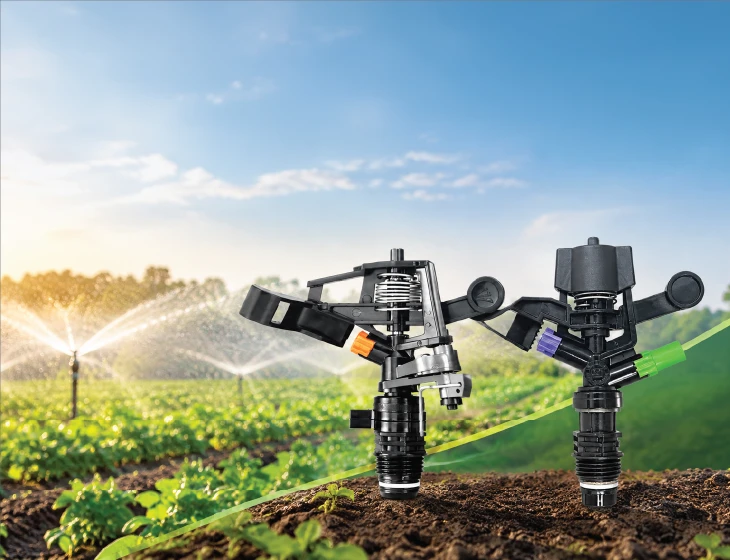
Several models in the available range use engineering plastic. These include the HT-22, HT-22U, HT-22 XU, HT-22W and HT-22PC, each designed for different agricultural applications.
The HT-22, for example, is suitable for agricultural fields, germination, vegetables, flowers and nurseries. It uses colour-coded nozzles and has a bayonet arrangement. Its operating pressure is 2.0 to 4.0 kg/cm², with spacing of up to 12 metres and a radius of up to 11 metres.
The HT-22U is designed for crops such as potato, onion, garlic, ginger, cabbage, cauliflower, strawberry, groundnut, mustard and pulses. It is intended to provide uniform moisture and can also be used for fertilizer application.
So, when looking at a plastic rain gun, the material is only the starting point. The model's specifications and intended application are what determine whether it fits a particular field.
Coverage and spray pattern matter
A rain gun needs to distribute water according to the requirements of the crop and field. Different models offer different radii, spacing and operating pressures.
The HT-22 XU, for example, is intended for closely spaced crops including potato, leafy vegetables, cotton, oilseeds, pulses and fodder. It can operate at 0.7 bar and has a radius of up to 11 metres.
The HT-22PC is a part-circle model intended for field edges, gardens, vegetables, flowers and potatoes. Its part-circle pattern can be useful where irrigation needs to remain within a particular section.
This is why a rain gun sprinkler should be selected based on the irrigation layout rather than simply its construction material.
Nozzles provide some flexibility
Rain guns may need to work across different crop stages and field conditions. Interchangeable nozzles provide flexibility for different crop and soil requirements.
Rain gun models also include an adjustable jet breaker, which allows droplet size and impact to be adjusted for delicate crops. A diffuser screw can be used when larger droplets are required depending on the location or crop stage.
The nozzle should match the designed rating of the equipment, and the correct nozzle size and appropriate tool should be used when replacing one.
A rain gun is part of a larger system
The sprinkler itself is only one component of the irrigation arrangement. A typical rain gun irrigation system can include mainline pipes, sub-main lines, rain guns, tripod stands and camlock fittings.
Mainlines can use PVC, HDPE or aluminium pipes. Rain guns can be mounted on tripod stands, either directly or with camlock quick-coupling fittings.
The system can also be portable. For fodder crops and green pastures, a rain gun can cover around one acre from one position in two to three hours. The setup can then be moved to another position to cover the rest of the farm.
Pressure and field conditions matter
The operating pressure of the available models varies, so the selected equipment needs to suit the pressure available in the irrigation setup.
Spacing also needs attention. Square and triangular spacing can be worked out based on the throw of the rain gun. For pipe runs longer than the recommended 200 to 300 metres from the water source, the next pipe size should be selected.
Wind is another factor. Excessive use in high wind velocity should be avoided, as field conditions can affect rain gun operation.
These considerations are useful when comparing an agricultural rain gun for farming, because the model cannot be separated from the conditions in which it will operate.
Where plastic models can make sense
The available plastic models cover a range of agricultural uses rather than being limited to one crop.
The HT-22 and its variants are used across vegetables, flowers, nurseries and field crops, while other models are designed for larger coverage or higher discharge. The HT-30PM, for example, is a high-discharge model intended for horticultural plantations, fruit trees, tuberous vegetables, pulses, oilseeds, sugarcane, tea, coffee, cereals and fodder.
It operates between 1 and 3 kg/cm², with a discharge of 1,255 to 3,550 litres per hour and a coverage diameter of 21.5 to 31.5 metres.
The important point is that plastic construction does not define the application on its own. Pressure, discharge, spacing, radius and nozzle configuration all need to be considered.
Think beyond the purchase price
Affordable irrigation equipment needs to make sense after it reaches the field too.
When considering water saving irrigation equipment, farmers need to look at how the equipment distributes water and whether its configuration suits the crop. Features such as adjustable jet breakers, interchangeable nozzles and different spray patterns provide options for adapting irrigation to different requirements.
The rain gun systems also use relatively few components, with lightweight and sturdy parts that are easy to install. Maintenance and the ability to move the equipment are also worth considering.
At Automat, we focus on irrigation solutions that support efficient water management while giving farmers equipment suited to different crops, field conditions and irrigation requirements.
Choosing the right model
There isn't a single answer for every farm. A plastic rain gun may be suitable where its pressure range, coverage, spacing and nozzle options match the field requirements.
Before choosing, farmers can start with a few straightforward questions. How large is the area that needs irrigation? What crop is being grown? What pressure is available? How much throw is required? Will the system remain in one place or need to be moved?
The answers can help narrow down the appropriate model and configuration.
A plastic rain gun sprinkler can be viewed as one choice among a larger variety of irrigation equipment. Its suitability comes down to how well its specifications match the conditions in which it will be used.
Conclusion
Choosing affordable irrigation equipment isn't simply about finding the lowest purchase price. The equipment also needs to work with the field, crop, water pressure and irrigation layout.
Plastic rain guns offer configurations for agricultural applications ranging from vegetables and nurseries to field crops, plantations and fodder. Different models provide different operating pressures, radii, spacing and discharge levels, while interchangeable nozzles and adjustable spray features provide additional flexibility.
At Automat, we continue to work on irrigation solutions designed around practical water management needs. For farmers, the most useful choice is ultimately the one that matches the equipment's capabilities with the actual requirements of the field.
FAQs
What is a plastic rain gun?
A plastic rain gun is a sprinkler designed to irrigate larger areas with a relatively long water throw, with different models offering different pressure, flow and coverage ranges.
Which crops can be irrigated using a plastic rain gun?
Depending on the model, it can be used for crops such as wheat, sugarcane, vegetables, pulses, maize, fodder, flowers and nursery plants.
How much water pressure does a plastic rain gun require?
The required pressure varies by model. The available rain guns operate across different pressure ranges, from low-pressure applications to models requiring up to 7.5 kg/cm².
Are plastic rain guns suitable for large agricultural fields?
Yes, certain models are designed for large-area irrigation, with some offering spacing of up to 18 metres and coverage suited to field crops and plantations.
How can plastic rain guns be maintained for better performance?
Use the correct nozzle and tools, keep the components properly fitted, avoid excessive use in high winds and have non-rotating units checked to identify the cause.

Download Mobile App


Get in touch

Plot no. 18-19, Dilshad Garden, G.T. Road, New Delhi 110095.


