
Popular Searches
Popular Searches

Things to Consider Before Installing Mini Sprinklers for Onion and Garlic
Onion and garlic develop shallow, compact root systems, with bulbs forming close to the soil surface. Because of this, water does not move very deep before the plant reacts.
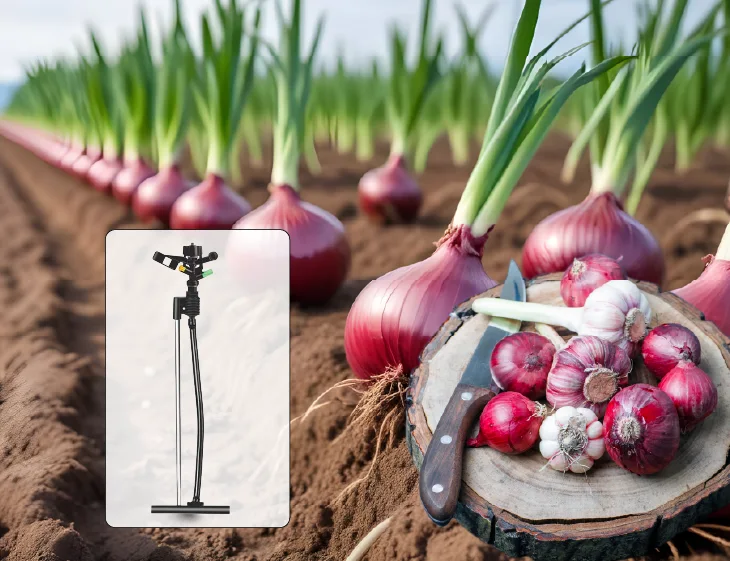
Onion and garlic develop shallow, compact root systems, with bulbs forming close to the soil surface. Because of this, water does not move very deep before the plant reacts. Even small differences in how the soil surface gets wet can affect bulb development and final size. This makes the irrigation method and sprinkler layout more important for these crops than for vegetables with deeper roots.
In fields where water application is uneven, onions and garlic usually show stress early. Bulb size starts varying, growth becomes patchy, and uniformity is hard to recover later. For these crops, irrigation is less about volume and more about how consistently water reaches the soil surface.
Understanding how onions and garlic use water
Both onion and garlic depend on moisture in the top layer of soil. Their roots spread sideways rather than going deep, so they draw water from a limited zone close to the surface. Once that zone dries out, the crop feels it quickly, even if there is moisture lower down.
This makes timing just as important as quantity. Long gaps between irrigations allow the surface to dry too much, while excess watering can reduce air around the bulb. In practice, irrigation works best when it keeps surface moisture steady instead of trying to soak the soil deeply.
Why sprinkler choice matters more than expected ?
Some crops manage fine even when watering isn’t perfectly even. Onion and garlic don’t really give that leeway. They do better when water lands gently and covers the bed evenly from end to end.
When droplets hit too hard or the overlap isn’t right, the soil surface gets disturbed and dry bands start forming between plants. That’s why many farmers lean toward a mini sprinkler irrigation system. It applies water more slowly and spreads it out more evenly. When the layout is done properly, moisture soaks in without runoff or crusting, which matters more once bulbs start forming.
Mini sprinkler irrigation system installation considerations
During mini sprinkler irrigation system installation, accuracy matters more than speed. Sprinkler spacing, riser height, and nozzle choice all affect how evenly water reaches the ground.
For onion and garlic fields, sprinklers are usually placed closer together than they would be for larger crops. This helps maintain overlap and avoids alternating wet and dry bands across the bed. Wind exposure also needs to be considered, since lighter droplets can drift if spacing is stretched too far.
After installation, the system should be checked visually. Walking the field while it is running often shows uneven wetting that pressure readings alone do not reveal.
Matching irrigation to onion irrigation method
Onion watering usually shifts as the crop moves along. In the early weeks, the plants do better with lighter, more frequent irrigation while the roots are still settling in. Once bulbs begin to form, water is still needed regularly, but too much moisture around the neck can start causing problems.
Mini sprinklers suit this kind of schedule well because run times can be adjusted easily without changing the layout. When the soil surface stays evenly moist, bulb growth stays steadier and the crop handles these sensitive stages with less stress.
Garlic crop water management in real field conditions
Garlic is managed much the same way, although it usually doesn’t need water as often. The bulb grows below the surface, but the crop still depends heavily on moisture near the topsoil during its early and middle growth stages.
One of the trickier parts with garlic is knowing when to start cutting back on water as harvest gets closer. When irrigation is even and not too heavy, it’s easier to slow things down at the right time without disturbing the soil or stressing the crop.
Choosing between field and garden applications
A garden mini sprinkler irrigation system is smaller, but the basics don’t really change. Onions and garlic still struggle when watering is uneven, whether they’re in a large field or a small plot.
The goal in both cases is to keep moisture consistent across the planted area. Differences usually come down to spacing and flow rate, not the overall approach.
Small sprinkler irrigation system spacing and pressure
In a small sprinkler irrigation system, pressure needs a bit of attention. Too much pressure throws heavier drops that can rough up the soil surface. Too little, and the sprinkler struggles to turn properly, leaving uneven patches behind.
Mini sprinklers are meant to run at gentler pressures, which works well for onion and garlic. When pressure stays in the right range, rotation stays smooth and water spreads evenly without needing constant correction.
Also Read: How to Find a Mini Sprinkler Irrigation System That Works for You ?
Getting the mini sprinkler setup right
A good mini sprinkler setup balances spacing, pressure, and operating time. Water should be applied slowly enough for the soil to absorb it, but evenly enough to avoid dry pockets between plants.
When this balance is achieved early in the season, there is less need for corrective irrigation later. Onions and garlic tend to grow more uniformly, with fewer variations in bulb size across the field.
Maintenance and long term consistency
Mini sprinkler systems need regular, simple checks. Filters should be cleaned, nozzles checked for blockage, and rotation observed from time to time.
Because onions and garlic react quickly to changes in surface moisture, even small issues can show up in the crop. Looking over the system once in a while helps fix small issues before they show up in the crop.
Field based design approach
At Automat, irrigation design starts from what actually happens in the field. Instead of relying only on specifications, the focus stays on how crops respond over the season and how systems hold up after repeated use. For onion and garlic, that means keeping surface wetting even, pressure steady, and day-to-day operation simple.
Conclusion
Onion and garlic place higher demands on irrigation accuracy because of their shallow roots and surface level bulb development. Small differences in wetting can affect yield and quality, making layout and operation especially important.
A well planned mini sprinkler irrigation system helps maintain steady moisture, protects soil structure, and gives growers better control as the crop develops. When spacing, pressure, and timing fall into place, irrigation needs far less attention and simply gets on with the job in the background. This practical, field driven thinking continues to shape how irrigation solutions are approached at Automat.
FAQs
Are mini sprinklers good for onion crops?
Yes. They work well for onions because they spread water gently across the surface, which suits how onion bulbs grow.
Can garlic be irrigated using mini sprinklers?
Yes. Garlic responds well to steady surface moisture, and mini sprinklers provide that without overdoing it.
Does an onion need a lot of water?
No. Onions prefer regular, light watering. Too much water can do more harm than good.
What is the best way to water onions?
It works better to keep the soil gently moist across the surface, especially once bulbs start forming, instead of letting water sit deep in the ground.
How much water is needed for garlic?
Garlic does best with steady moisture. Once the plants are established, there’s usually no need to water heavily.

Download Mobile App


Get in touch

Plot no. 18-19, Dilshad Garden, G.T. Road, New Delhi 110095.


