
Popular Searches
Popular Searches

How Are Overhead Sprinklers Used for Wheat, Groundnut, Vegetables and Other Indian Crops?
Wheat, groundnut and vegetables may all be irrigated with overhead sprinklers, but their irrigation requirements are not identical. Crop spacing, growth stage, soil type, field size and the required water application rate can all influence how sprinkler irrigation should be planned.
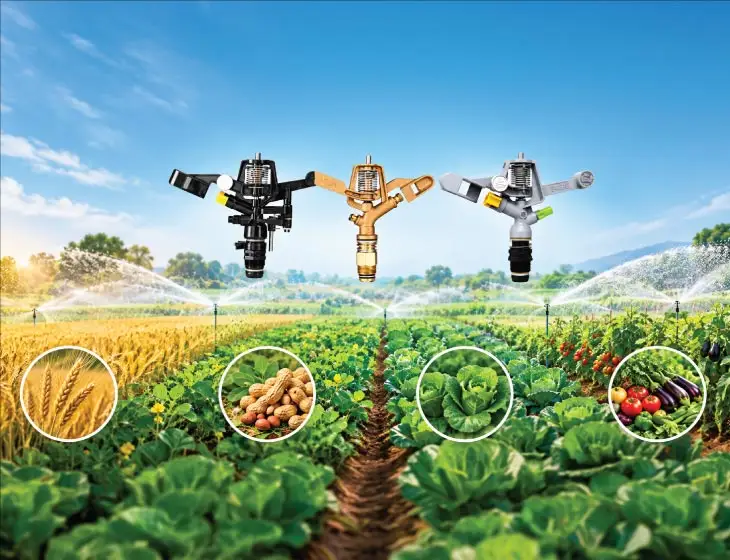
Wheat, groundnut and vegetables may all be irrigated with overhead sprinklers, but their irrigation requirements are not identical. Crop spacing, growth stage, soil type, field size and the required water application rate can all influence how sprinkler irrigation should be planned.
This means that using overhead sprinklers across different Indian crops is not simply a matter of installing the same equipment everywhere. The sprinkler type, spacing, operating pressure and irrigation schedule may need to be considered according to the crop and field conditions.
Understanding these factors helps determine where overhead sprinklers can be used effectively for wheat, groundnut, vegetables and other crops grown across India.
Start with the crop you are growing
A useful place to begin is the crop itself.
The sprinkler that works well for one field may not necessarily be the right fit for another. The product range includes models specifically listed for wheat, groundnut, vegetables, pulses, oil seeds, cereals, tuberous crops and several other agricultural applications.
The reason for looking at crop compatibility first is fairly simple. Sprinkler spacing, coverage and operating pressure all affect how water is distributed across the field. Those details need to suit the crop and the way the field is laid out.
For farmers managing more than one crop, this can also mean choosing equipment that can work across different applications rather than selecting a sprinkler based on one crop alone.
What works for wheat?
Wheat appears across several of the sprinkler applications in the range. The HT-46 Saaras, for example, is recommended for wheat, maize, peas, cumin, cotton and vegetables. It can be used with portable as well as solid set systems, with a recommended pressure range of 1.0 to 4.0 kg/cm² and spacing of up to 12 metres for higher distribution uniformity.
The HT-46PC is another option listed for wheat and other crops suitable for overhead irrigation. Its recommended spacing goes up to 15 metres, with a 1.0 to 4.0 kg/cm² pressure range.
There are also larger sprinklers listed for wheat. The HT-25 has a recommended spacing of up to 18 metres, while the HT-30 goes up to 21 metres. Both are intended for crops that can be irrigated through overhead systems, with wheat specifically mentioned in their crop recommendations.
This means the sprinkler can be selected according to the actual field arrangement rather than treating a sprinkler irrigation system for wheat as a single fixed setup.
Groundnut has its own sprinkler options
Groundnut is specifically included in the crop recommendations for both the HT-22U and HT-20PH.
The HT-22U is a mini sprinkler designed for crops including potato, onion, garlic, ginger, cabbage, cauliflower, strawberry, groundnut, mustard, pulses, tea and nursery applications. It is described as providing uniform water application and maintaining soil moisture, with a low application rate of 4 to 5 mm/hr. The recommended distance between sprinklers is 8 to 12 metres.
The HT-20PH is a different option. Its recommended crops include groundnut, jowar, paddy and vegetables. It has a recommended pressure range of 1.0 to 3.0 kg/cm² and can perform well at 0.5 kg/cm², which is relevant where the available pressure is lower.
Neither model should be treated as automatically suitable for every groundnut field. The field layout, available pressure and required coverage still need to be considered before deciding on the arrangement.
Vegetables need attention to distribution
Vegetable crops feature prominently across the sprinkler range, including models intended specifically for irrigation and germination.
The HT-22 is recommended for agriculture fields as well as the germination of vegetables, flowers and nursery crops. It has a recommended spacing of up to 12 metres and a coverage radius of 11 metres.
The HT-22XU is intended for closely spaced field crops such as leafy vegetables, cotton, oil seeds, pulses and fodder crops. It is also recommended for vegetable, flower and nursery germination. One of its notable specifications is its ability to operate at pressures as low as 0.7 bar.
The HT-22W is another model suggested for irrigation and germination of vegetable and nursery crops by overhead irrigation. Its recommended spacing is up to 12 metres, with a coverage radius of 10 metres.
For farmers looking at overhead irrigation for vegetables, these differences are worth paying attention to. A vegetable field may need a different sprinkler arrangement from a larger field crop, particularly where crops are planted more closely together.
Field edges need a different approach
Water distribution at the edge of a field is not quite the same as distribution in the middle. Field edges need a little more attention because the sprinkler arrangement may need to be different overhead irrigation system from the one used across the main field. That is where part-circle models can be useful.
The HT-22PC is designed for efficient irrigation of field edges and can also be used for vegetables, flowers and potatoes. The HT-46PC is another part-circle model recommended for wheat, maize, peas, cumin, cotton, vegetables and other overhead irrigation crops.
There are similar options in the metal range, including the HT-20PC and HT-30B. These are designed for field-edge irrigation while retaining the wider application range of their respective sprinkler types. So, when planning overhead irrigation sprinklers, the position of the sprinkler within the field matters just as much as the sprinkler itself.
Pressure and spacing go together
It is tempting to focus on how far a sprinkler can throw water. But coverage alone does not tell you whether a particular model suits the installation.
Every sprinkler has a recommended operating pressure and spacing. For example, the HT-46 has a recommended pressure range of 1.0 to 4.0 kg/cm² and spacing up to 12 metres. The HT-30P works at 2.0 to 5.0 kg/cm² and can be spaced up to 18 metres. The AQ-30P has a pressure range of 2 to 5 kg/cm² and recommended spacing of up to 18 metres.
The HT-30PM goes up to 18 metres spacing as well, with a pressure range of 1 to 3 kg/cm² and a coverage diameter between 21.5 and 31.5 metres. These figures also show why the available pressure and field size need to be considered when choosing a sprinkler.
A sprinkler set for Indian farmers may need to be flexible
Many Indian farms are not growing just one crop throughout the year. Fields can be used for different crops, and irrigation arrangements may need to accommodate those changes.
A versatile sprinkler can therefore be useful where the same irrigation infrastructure is expected to serve different crops. The HT-30PM, for example, is listed for horticultural plantations, leguminous plants, fruit trees and field crops including tuberous vegetables, pulses, oil seeds, sugarcane, tea, coffee, cereals and fodder.
The AQ-30P is also designed for versatile use across crops requiring overhead irrigation. It has a 1-inch BSP/NPT female threaded connection and recommended spacing of up to 18 metres. It is available with brass or plastic threaded nozzles and includes an integrated stream straightening vane.
The right sprinkler set for Indian farmers, then, is not necessarily the one with the largest coverage. It is the one whose pressure, spacing, connection and crop suitability fit the actual farm.
Where does micro sprinkler irrigation fit?
It is worth separating sprinkler types rather than treating every sprinkler as interchangeable.
The products covered here are primarily impact sprinklers designed for overhead irrigation. Some are intended for field crops, while others are specifically suited to vegetable and nursery applications or closely spaced crops.
Micro sprinkler irrigation is a different irrigation approach, so it should not be treated as interchangeable with the impact sprinklers described here. The choice should start with the irrigation method required for the particular field and crop.
Larger fields can call for larger sprinklers
Field size is another practical consideration. The range includes Overhead Sprinklers with different coverage and spacing capabilities. The HT-22 models generally have recommended spacing around 8 to 12 metres, while models such as the HT-30P, HT-30PM and AQ-30P can be used at spacing of up to 18 metres.
The HT-30 has recommended spacing of up to 21 metres and a coverage radius of 21 metres. Its crop recommendations include cumin, wheat, mustard and garlic.
This does not mean that the largest sprinkler should automatically be used on the largest field. Pressure, flow rate, crop requirements and the desired distribution still have to line up. Larger spacing only becomes useful when the rest of the irrigation arrangement can support it.
We look at more than just the crop
At Automat, we work with irrigation equipment designed around different agricultural applications, including field crops, vegetables, fruit farming and horticultural plantations. The sprinkler range includes engineering plastic, brass, bronze and aluminium models, with different pressure ranges, connections, coverage and spacing.
For example, the HT-20CS(XR) Garud uses a heavy-duty aluminium body and arm and is designed to perform in strong winds. The HT-20PH is recommended for groundnut, jowar, paddy and vegetables, while the HT-46 is listed for wheat, maize, peas, cumin, cotton and vegetables.
Looking at these differences is important because there is no single set of specifications that applies to every field.
Choosing the right overhead irrigation system
A good starting point is to list the crops that will actually be irrigated and then look at the field layout.
From there, pressure, sprinkler spacing, coverage, connection size and whether the system is portable or solid set can all be considered. For field edges, a part-circle model may make more sense. For closely spaced crops, a model specifically designed for those applications may be more appropriate.
There are also situations where Overhead Sprinklers can serve several crops. The HT-46, for instance, is listed for both wheat and vegetables, while the HT-30P can be used for crops including wheat, mustard, bajra, strawberry and garlic.
The choice is therefore not simply about finding the sprinkler with the widest throw or the largest coverage area. It is about seeing how the specifications fit together with the crop and field.
In the end, choosing an for Indian agriculture is less about finding one sprinkler that works for everything and more about finding the right combination for the particular field. Wheat, groundnut, vegetables and other crops can all be suited to overhead irrigation, but the details of the setup still matter.
The crop, field size, available pressure, spacing and required coverage should all have a place in the decision. Once those factors are clear, choosing between the different sprinkler options becomes a much more practical exercise.
FAQs
Where should sprinkler heads be placed?
Sprinkler heads should be positioned according to the crop, field layout and the recommended spacing of the sprinkler being used. Field edges may need part-circle sprinklers for more suitable coverage.
Which crops are suitable for overhead sprinkler irrigation?
Wheat, groundnut, vegetables, pulses, oil seeds, cereals, nursery crops and several other crops are listed as suitable for overhead irrigation with different sprinkler models.
Are overhead sprinklers suitable for wheat cultivation?
Yes. Several models, including HT-46, HT-46PC, HT-25 and HT-30, are specifically listed for wheat and can be used in different field arrangements.
How do overhead sprinklers improve water distribution?
Sprinklers spread the water over a given area of coverage. The uniformity of the application to the field depends on the design of the nozzle, the spacing and operating pressure.
What factors should be considered when selecting overhead sprinklers?
Look at the crop, field size, available pressure, required coverage, sprinkler spacing, connection size and whether a portable, solid-set or part-circle setup is needed.

Download Mobile App


Get in touch

Plot no. 18-19, Dilshad Garden, G.T. Road, New Delhi 110095.


