
Popular Searches
Popular Searches

Why Drip Irrigation Filters are Important for Farmers?
Clean water is at the heart of any good irrigation setup. Without it, the lines clog, pressure drops, and crops stop getting what they need.
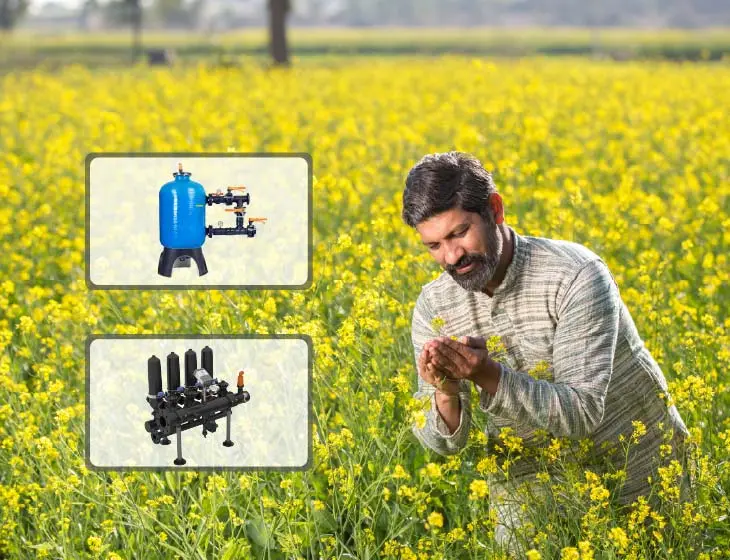
Clean water is at the heart of any good irrigation setup. Without it, the lines clog, pressure drops, and crops stop getting what they need. A good drip irrigation filter keeps the whole system running smoothly day after day, making it a farmer's must-have.
Why Filters Matter So Much ?
Even if the water looks clear, it usually carries bits of sand, silt, and other impurities. These small things are enough to block tiny emitters inside a drip line. When that happens, there is uneven irrigation in the field - some parts of the field get too much water while others stay dry.
An irrigation filter system removes that dirt from the irrigation pipes and keeps the water flowing evenly so that the system doesn’t choke or slow down. For a farmer, it’s one less thing to worry about, with fewer blockages, fewer fixes, and a lot more peace of mind.
Understanding How Drip Irrigation Works
In drip irrigation, the water doesn’t rush through the field, but rather moves slowly through narrow pipes and falls right near the roots, bit by bit. The soil takes it in properly, and nothing gets wasted in puddles or runoff.
Once you understand how drip irrigation works, you realize the system depends on clean, steady pressure more than anything else.
The First Line of Defense
When water is drawn from open wells, ponds, or canals, it often brings sand and silt along with it. A Hydro Cyclone Filter handles this part, working in a pretty clever way.
When water enters, it spins around inside the cone-shaped body. That swirl makes the heavier bits like sand move to the edges and settle down in a small chamber, while the cleaner water rises and flows out through the top.
Models like Automat’s HT-144, HT-145, and HT-146 are built exactly for this. Made from reinforced polypropylene and nylon, they can handle pressures up to 6 kg/cm². They are easy to maintain too and the dirt that collects can be flushed out from the bottom drain without dismantling anything.
Simply put, this kind of water filter for drip irrigation system takes care of the heavy stuff first, so the rest of the setup can run freely.
Next Comes Fine Filtration
After sand is removed, water still carries smaller impurities that can block emitters. That’s where a drip irrigation disc filter or a screen filter comes in. These handle finer particles.
Disc filters are made up ridged discs stacked together. When water flows through them, the tiny grooves catch bits of dirt and debris. They don’t take up much space, are simple to clean, and can keep working for a long time if you just give them regular care. When combined with a Hydro Cyclone Filter, they make a strong two-step filtration system where one removes sand and grit, the other clears the finer dust and algae.
Screen filters play a similar role but use a fine stainless-steel mesh instead of discs. As water passes through, the screen traps floating dirt, algae, and organic matter that the Hydro Cyclone can’t catch. Automat’s Y-Type Screen Filters (HT-121Y to HT-124Y series) are built for this kind of precision as they are compact, easy to open and clean, and available in a range of flow capacities. Used alongside disc filters, they make sure every drop reaching the drip line is as clean as it should be.
Why Filtration Makes Everything Work Better ?
Clean water keeps the pressure even across the field. When filters are doing their job, water spreads evenly, emitters stay clear, and crops grow at a steady pace.
Filtration also helps in protecting other equipments like the valves, pumps, and regulators, from early wear. Without filters, debris can scratch, block, or strain them over time. With filters in place, the whole setup runs quietly and efficiently.
So, when farmers ask can drip irrigation save water, the real answer is yes, but only if the filters keep the water clean and the flow steady.
Making Maintenance Easier: The Autoflush Kit
Cleaning filters manually can be a hassle, especially when you’re managing several acres. Automat’s Autoflush Hydro cyclone Filter Kit was made to solve exactly that.
It uses an automatic flushing process that clears out trapped sand and dirt without stopping irrigation. The controller can be set to flush at regular intervals, for example, once every hour for a few seconds, and it works on its own.
Once installed, it doesn’t need constant checking. It saves both time and effort while keeping the system in top condition all season.
When it comes to fine filtration, Automat’s automatic and semi-automatic disc and screen filters like the AquaDisc and Turbo models, take a lot of the work off the farmer’s hands. They clean themselves on schedule using sensors or timers, so irrigation doesn’t have to stop. The water used for cleaning is minimal, and the flow stays smooth right through the cycle.
How Filtration Helps in Real Fields ?
In most farms, the difference starts showing after a few weeks. Crops look more even, the irrigation schedule runs on time, and there’s less time spent opening clogged lines. Once farmers see that change, filters stop feeling like “extra fittings” and start feeling like quiet, dependable helpers.
In sandy regions, hydrocyclones do the heavy lifting; in areas that draw water from ponds or canals, disc and screen filters handle the finer mess. What matters most is that together, they keep the system predictable.
Different Water, Same Solution
No two farms use the same kind of water. Some pull from deep borewells, some from rivers, others from small tanks. What filtration does is make those sources behave the same way. Clean, steady, and easy to manage.
The type of filter changes, but the goal doesn’t. They make sure every drop that reaches the field is worth its effort.
A Bit of Care Goes a Long Way
A few small habits make the whole system last longer. Checking pressure gauges, flushing tanks, or letting the auto-cleaning function run its cycle, is all it takes to keep things working right.
Once farmers see that a clean filter means one less surprise in the field, they tend to stick to the routine without reminders.
Why It All Adds Up
A well-kept drip irrigation filter doesn’t just protect equipment. It keeps the whole system from demanding your time every other day. Systems run longer between checks, pumps work lighter, and even fertilizer mixes distribute better. Over months, that turns into real savings, of both water and energy.
Wrapping It Up
At Automat, the goal has always been simple: help farmers make their drip irrigation filter system last longer and perform better. The right mix of filters doesn’t just clean the water; it builds consistency. And in farming, consistency is what turns one good season into many.
FAQs
How do drip irrigation filters work?
They trap sand, silt, and dirt before the water reaches the drip lines, keeping the flow smooth and even.
How to control water flow in drip irrigation?
Farmers usually use valves or regulators to adjust the pressure and control how much water each section gets.
Do I need a filter for drip irrigation?
Yes, absolutely. Without a filter, tiny emitters can clog quickly, and the system won’t water evenly.
What types of filters are used in drip irrigation?
Most setups use Hydro Cyclone Filters for sand and disc or screen filters for finer particles.

Download Mobile App


Get in touch

Plot no. 18-19, Dilshad Garden, G.T. Road, New Delhi 110095.


