
Popular Searches
Popular Searches
Drip Filtration Best Practices for High-Yield Tomato and Chili Fields
Tomato and chilli fields usually run drip lines with emitters placed close together. It’s a setup that works well for dense crops, but it leaves little room for error.
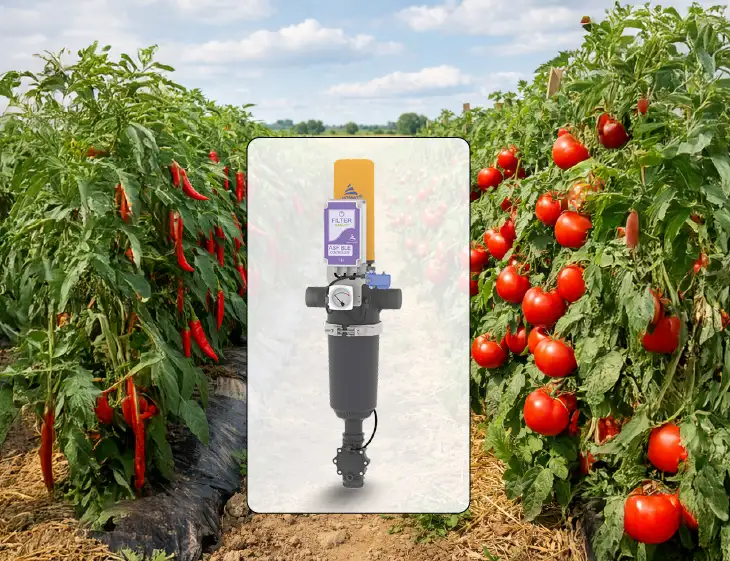
Tomato and chilli fields usually run drip lines with emitters placed close together. It’s a setup that works well for dense crops, but it leaves little room for error. When even small amounts of algae or organic matter slip through, several emitters can clog at once, and filtration suddenly becomes critical rather than optional.
Once clogging starts, it rarely stays limited to one spot. A few blocked emitters can quietly expand into uneven wetting patterns, and by the time plants show stress, the damage is already underway. This is why filtration choices carry more weight in tomato and chilli irrigation than they might in wider spaced crops.
Why filtration carries extra weight in tomato and chilli cultivation ?
Tomato and chilli plants depend on consistent moisture near the root zone, especially once flowering and fruit development begin. Unlike crops that tolerate wider moisture swings, these plants respond quickly to interruption. A short-term reduction in discharge can affect fruit size, set, and uniformity across the plot.
In drip systems, water reaches the plant through narrow emitter passages. Any suspended particle, organic residue, or algae fragment that slips past filtration can lodge inside these passages. Over time, this restricts flow or shuts it off entirely. Because emitters are closely spaced, multiple plants may be affected by a single filtration lapse.
This is where a well matched drip irrigation filter becomes less of a safeguard and more of a core system component.
Water sources and organic load in Indian conditions
In many Indian farms, tomato and chilli irrigation draws water from reservoirs, canals, farm ponds, or mixed storage systems. These sources often contain fine organic matter that is not immediately visible. Algae, decaying plant residue, and biological particles tend to fluctuate with season and temperature.
Sand and grit are usually easy to stop. Organic matter is trickier. It can squeeze through filters, change shape, and later settle inside emitters. That’s why filter choice and cleaning matter more in vegetable systems that run every day.
A drip irrigation filter system must handle these variations without needing constant manual intervention, particularly during peak crop stages when irrigation runs longer hours.
Understanding drip irrigation filter types and their role
When looking at drip irrigation filter types, the main difference lies in how particles are trapped and released during cleaning.
Sand media filters are used as primary filtration for open water sources, trapping organic matter, silt, and clay before water reaches finer filters.
Screen filters rely on a fixed mesh, which works well for uniform particles but can struggle with biological matter that sticks or smears.
Disc filters, by contrast, trap particles across stacked grooved surfaces. This increases filtration area and improves capture of organic material. During backflushing, these discs separate and release trapped matter more effectively, restoring filtration capacity without dismantling the unit.
For tomato and chilli fields using surface or mixed water sources, this difference often shows up as fewer clogging incidents across the season rather than higher pressure readings on day one.
Filtration performance during long irrigation cycles
Tomato and chilli irrigation schedules often extend as the crop matures. Once fruiting begins, drip runs are usually kept a bit longer so the soil doesn’t dry out between cycles. This puts sustained load on filters.
If a filter cannot clean itself efficiently at lower pressures, trapped material accumulates. As this builds up, water starts losing pressure and the far end of the line feels it first. Automated disc filters that clean based on differential pressure help manage this without stopping irrigation.
The AquaDisc HF Automatic Disc Filters are designed with this operating reality in mind. Their spray jet cleaning mechanism allows effective backflushing even at lower pressures, which is important in vegetable systems where pump output may fluctuate.
Sand media filters play a supporting role here by handling higher organic load early in the system. By removing silt and biological matter before water reaches finer filters, they help prevent faster buildup during long irrigation cycles.
Managing tomato drip irrigation setup over the season
A tomato drip irrigation setup changes as the crop grows, with shorter runs early on and longer, steadier cycles later. If filtration slips in the early stages, the impact often shows up only when demand rises, by which time the issue is harder to trace. Stable filtration ensures irrigation changes reach the plants, not get lost in the system.
Filtration and chili crop irrigation management
Chilli plants react quickly to water stress, especially once flowering and fruiting begin. If wetting isn’t even, fruit size and quality start varying across the field.
Good chilli crop irrigation management depends on keeping discharge uniform, which is why filters that clean well and handle pressure changes matter more than they’re often given credit for.
Maintenance realities in the field
Even with automatic cleaning, filters still need to be checked now and then. Pressure readings usually tell the story early, especially in hot weather when organic matter builds up faster. A quick look at the system from time to time goes a long way in keeping irrigation steady through the season.
Design approach shaped by field use
At Automat, filtration is designed for real field conditions, where water quality and pressure are rarely consistent. The AquaDisc HF Automatic Disc Filters along with sand media filters used as primary filtration for higher organic loads, are built to handle organic matter reliably and keep drip systems performing steadily through long irrigation cycles.
Closing perspective
In tomato and chilli fields, filtration quietly decides how evenly water actually reaches the crop. When emitters are close together and irrigation runs often, small filter issues show up fast. Getting filtration right keeps water moving where it should, makes irrigation easier to manage, and lets growers focus on the plants instead of fixing the system.
FAQs
What is the best way to drip irrigate tomatoes?
Use short, frequent drip cycles that keep the root zone evenly moist, and make sure filtration stays reliable so all emitters perform the same.
What is the primary source of drip irrigation?
Most drip systems draw from reservoirs, canals, farm ponds, or stored surface water, depending on local availability.
Which drip filter is best for tomatoes?
Disc filters are usually preferred because they handle organic matter better and reduce the risk of emitter clogging.
Is the same filter suitable for tomato and chili?
Yes. Since both crops use closely spaced emitters and frequent irrigation, they benefit from the same level of filtration.
What happens if drip filtration is ignored?
Emitters begin to clog unevenly, water distribution breaks down, and crop stress shows up before the problem is easy to spot.

Download Mobile App


Get in touch

Plot no. 18-19, Dilshad Garden, G.T. Road, New Delhi 110095.


