
Popular Searches
Popular Searches

What Makes Brass Sprinklers Work Better in Mustard Fields ?
Mustard fields tend to reveal irrigation inconsistencies faster than many other crops. The plant responds quickly to uneven moisture, and once gaps appear, they are hard to correct mid-season.
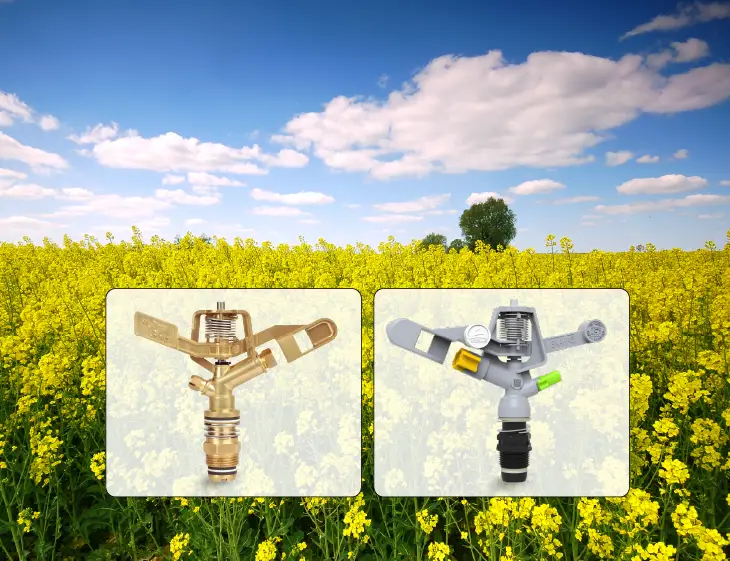
Mustard fields tend to reveal irrigation inconsistencies faster than many other crops. The plant responds quickly to uneven moisture, and once gaps appear, they are hard to correct mid-season. That makes sprinkler choice less about convenience and more about consistency over time.
In mustard cultivation, irrigation does not need to be heavy, but it does need to be predictable. When water application varies from one section to another, crop growth begins to spread unevenly across the field. Over time, these differences reduce uniformity and affect overall output.
This is where sprinkler design and material start to matter more than expected.
Understanding mustard crop water requirement
The mustard crop water requirement sits somewhere in the middle when compared to many other field crops. It doesn’t need watering too often, but it also doesn’t handle extremes very well. Long dry spells slow the crop down, while too much water starts affecting the roots and how nutrients are taken up.
What really matters is keeping moisture reasonably even during the important stages of growth. Systems that deliver water unevenly make this harder than it needs to be. If one cycle runs heavier and the next runs light, the crop responds in patches, even when the overall water use looks fine on paper.
That’s why, in mustard fields, steady sprinkler performance usually matters more than pushing high discharge or trying to cover extra distance.
Why brass sprinkler construction matters in field conditions ?
A brass sprinkler is built to handle repeated use without losing its operating characteristics. In open fields, sprinklers are exposed to dust, wind, shifting pipes, and long run hours. Over time, lighter materials can begin to wear at pivot points or nozzle edges.
Brass parts tend to hold up better over time. The body, arm, and nozzle maintain their shape longer, which helps preserve spray pattern and throw radius across the season. This is particularly relevant in mustard fields, where irrigation intervals are spaced out and performance needs to remain stable between cycles.
Once installed, the sprinkler tends to behave the same way at the end of the season as it did at the start.
Brass sprinkler irrigation and uniform distribution
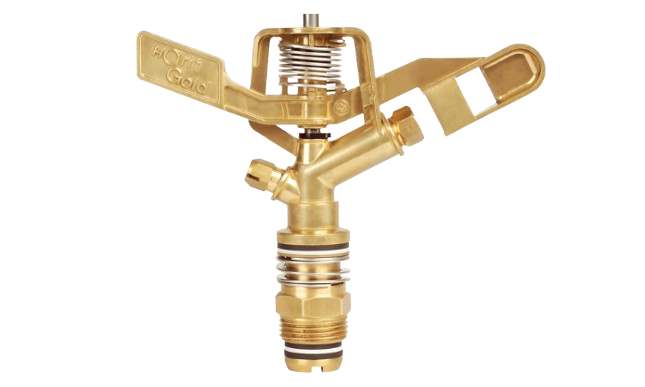
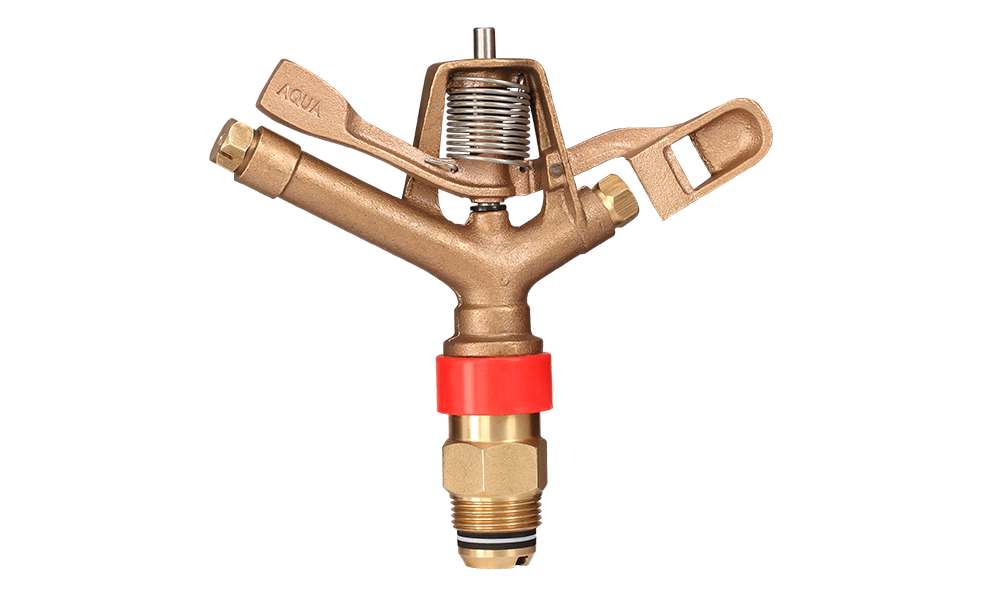
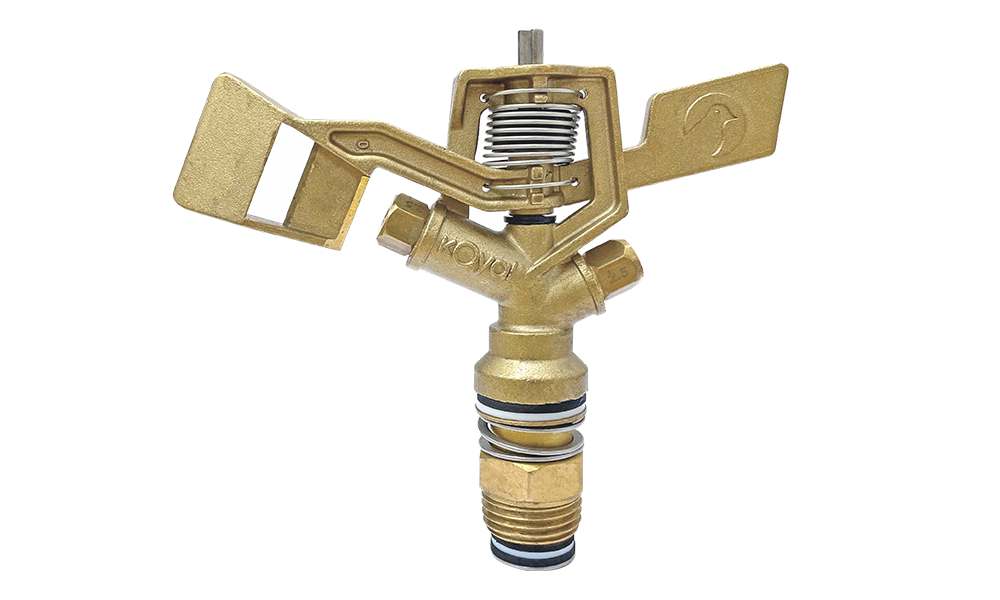
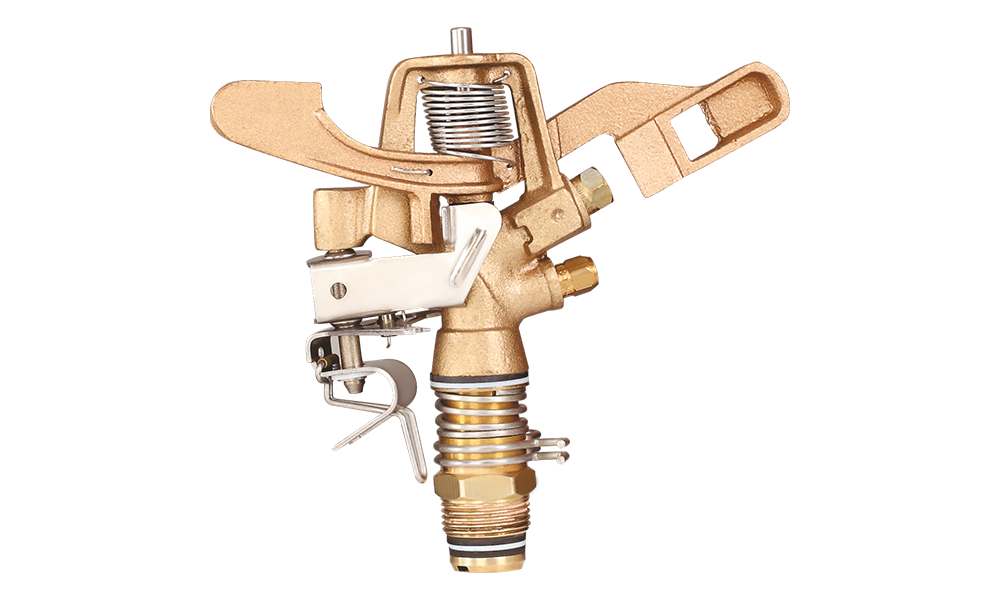
Brass sprinkler irrigation is often used in overhead systems where uniform coverage matters more than high application rates. In mustard fields, overhead irrigation works well when droplets are distributed evenly and soil surface disturbance is minimal.
Brass impact sprinklers rotate steadily even when preasure is on the lower side, helping the water spread outward instead of falling heavily near the base. When sprinklers are spaced properly, the overlapping spray keeps moisture more even across the field.
That consistency reduces dry spots and cuts down the need for extra watering later in the season.
Performance stability over long operating hours
In the rabi season, irrigation often ends up running longer, sometimes late into the night or early morning. That’s usually when weak spots start showing. Sprinklers slow down, the spray loses shape, and coverage becomes uneven without anyone noticing right away.
A brass sprinkler generally handles these long runs better. The arm keeps moving smoothly, rotation stays steady, and the spray doesn’t drift out of pattern as easily. Over time, that steadiness makes a difference.
It means less stopping to fix things and more confidence that each cycle is doing what it’s supposed to.
Fit within a rabi crop sprinkler system
Rabi irrigation usually runs in cooler weather, when water loss to evaporation is lower. Mustard suits this well since it doesn’t need frequent watering, only timely application.
Brass impact sprinklers work comfortably at lower pressures, which fits rabi schedules without pushing pumps or pipelines harder than necessary. This makes them easier to use in shared systems where several rabi crops depend on steady pressure across zones.
Sprinkler irrigation for oilseed crops
Sprinkler irrigation for oilseed crops works best when water is applied evenly and gently. Oilseeds, including mustard, respond poorly to surface runoff or localized overwatering.
Brass impact sprinklers produce droplets that are large enough to resist wind drift but controlled enough to avoid soil sealing. This way, water settles into the root zone without churning up the soil.
Over time, this improves moisture retention and supports uniform crop development across the field.
Comparing material behaviour in real field use
Farmers often use a mix of plastic sprinklers and metal sprinklers based on field needs. Plastic models are lighter and easier to handle, while metal sprinklers are chosen for durability and performance stability.
A metal sprinkler made from brass offers higher resistance to wear at impact points. Nozzle edges stay sharper for longer, and rotation does not slow down as quickly with repeated cycles. In mustard fields, where irrigation events are fewer but critical, this reliability becomes noticeable over time.
The goal is not higher output, but dependable output.
Choosing irrigation methods for mustard
In practice, mustard is watered through a mix of surface irrigation, drip systems, and sprinklers, based on what the field allows. Sprinklers are often preferred where land leveling is not perfect or where overhead coverage simplifies field layout.
Within sprinkler systems, the choice of material influences how long performance remains consistent. Brass sprinklers suit fields where irrigation schedules are fixed and corrective passes are difficult.
When the system delivers water the same way every time, crop response becomes easier to manage.
Practical field observations from long-term use
Over time, many farmers find that brass irrigation sprinklers don’t need as much fixing or replacing. They keep rotating smoothly, and the throw doesn’t drop off as quickly as it does with lighter units.
That matters in mustard fields, where the crop moves fast and irrigation delays can’t always be recovered. When equipment stays reliable through the season, irrigation stays on schedule without constant attention.
Design approach rooted in field performance
At Automat, we design sprinkler systems with long-term field use in mind. Performance on paper matters, but what matters more is how equipment behaves after months of regular operation under real conditions.
Brass impact sprinklers suit this approach because they do their job reliably, without asking for more attention or adjustment.
Regional suitability across Rajasthan mustard growing regions
In Rajasthan, mustard is widely grown across regions such as Bharatpur, Alwar, Sri Ganganagar, Hanumangarh, Sawai Madhopur, and Baran, covering parts of Eastern, Northern, and Western Rajasthan. These areas experience varying soil types, wind conditions, and pressure availability during the rabi season. In such diverse field conditions, irrigation equipment that delivers consistent performance becomes critical. Brass sprinklers tend to perform reliably across these regions, where long operating hours, dusty environments, and fluctuating pressure are common. Their stable rotation and uniform throw help maintain even moisture levels, supporting consistent mustard growth across Rajasthan’s major mustard-growing regions.
Conclusion
Mustard does best when water reaches the field evenly and on time. Once that balance slips, the crop shows it fast and there’s very little room to fix it later.
Using a brass sprinkler helps keep the throw and rotation steady through the season, which makes irrigation simpler to manage in a rabi crop sprinkler system. That kind of day-to-day reliability is what shapes how we think about irrigation design at Automat.
FAQs
What is the irrigation process of mustard?
Mustard is irrigated at specific growth stages, with even application rather than frequent watering.
Are brass sprinklers better than plastic for mustard?
In mustard fields, brass sprinklers usually keep their throw steady for longer without much fuss.
How much water does mustard need?
Mustard needs moderate, timely watering and does not respond well to excess moisture.
Do brass sprinklers save water?
They help avoid uneven watering, which reduces the need for repeat irrigation.
What sprinkler spacing is ideal for mustard?
Spacing is set based on throw radius, with enough overlap to maintain uniform coverage.

Download Mobile App


Get in touch

Plot no. 18-19, Dilshad Garden, G.T. Road, New Delhi 110095.


