
Popular Searches
Popular Searches

Why Rain Guns Work Well for High-Density Fodder Crops ?
When we talk about livestock farming, most of the attention goes to the animals themselves. Feed quality, nutrition, and milk production usually dominate the conversation.
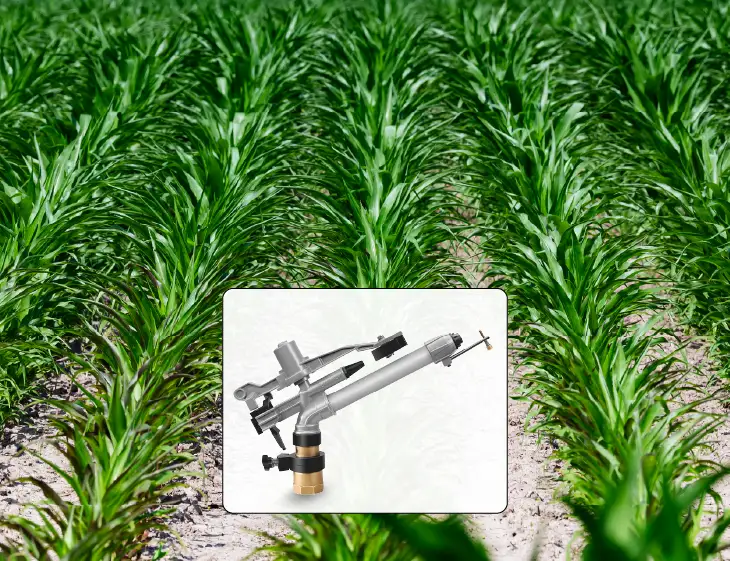
When we talk about livestock farming, most of the attention goes to the animals themselves. Feed quality, nutrition, and milk production usually dominate the conversation. But behind all of that sits something simpler. The fodder crop growing in the field.
If fodder does not grow evenly, animals eventually feel the impact. That is why irrigation becomes such an important part of managing fodder fields.
In regions like Uttar Pradesh, where farming remains closely tied to dairy and mixed agriculture, fodder crops are planted across large open plots. Crops such as maize fodder, pasture grass, and seasonal forage varieties grow thick and close together. Watering these dense fields evenly can become difficult with small sprinkler systems.
This is where Rain Guns begin to make practical sense.
Understanding irrigation needs in dense fodder fields
High-density fodder crops behave differently from widely spaced crops. The plants grow close together and quickly cover the ground surface. Within a short period, it becomes difficult for irrigation systems to move easily across the field.
Traditional irrigation layouts often require many small sprinklers placed close to one another. This increases pipeline length, adds more fittings, and can reduce pressure along the system.
A fodder crop sprinkler system that uses fewer but stronger sprinklers tends to work better in such situations. Wide-coverage irrigation allows water to spread across the crop canopy without requiring dozens of closely spaced units.
That is why many farmers turn to large rotating sprinklers that can reach across wider sections of the field.
Why wide coverage matters in fodder watering ?
Fodder crops grow thick because farmers want maximum biomass from each plot. However, dense growth also means irrigation must reach deep into the canopy.
During fodder watering, the goal is not just to wet the soil surface. Water must spread evenly across the entire field so that plant growth remains consistent.
Large rotating sprinklers help distribute water across wide areas without requiring multiple overlapping sprays. This helps avoid dry pockets where plants receive less moisture.
Even distribution becomes especially important in fodder fields because uneven watering often results in uneven crop height. That eventually affects harvesting and feed quality.
Rain Guns and their suitability for open fodder plots
Most fodder plots are open fields with very little in the way. That’s where Rain Guns work nicely. One unit can spread water across a big section of land, which means farmers don’t need to install many smaller sprinklers.
Using rain gun for pasture fodder fields
Pasture grass often grows over wide, open fields. A rain gun for pasture fodder makes irrigation simpler here since one unit can cover a large patch of land without setting up too many sprinklers.
Maize fodder rain gun irrigation in practice
Maize fodder is often planted in large fields. Using a maize fodder rain gun makes it easier to cover more ground from a single spot, which helps keep watering fairly even across the crop.
Mobility benefits in fodder irrigation systems
Fodder farming rarely stays fixed in one layout year after year. Crop rotation, seasonal planting, and land management often shift the position of fodder plots.
Because of this, many farmers prefer irrigation systems that can move with the field layout.
A mobile rain gun system fodder arrangement allows sprinklers to be mounted on stands or risers that can be repositioned when necessary.
This flexibility becomes useful during different planting cycles. Instead of installing permanent infrastructure, farmers can relocate sprinklers depending on the crop area.
On many farms the same field is used for different crops through the year, so being able to move the irrigation setup around becomes quite useful.
Supporting dairy farm fodder irrigation
Many dairy farms in northern India depend on fodder fields close to the shed. The crop needs steady watering to keep feed supply stable.
Proper dairy farm fodder irrigation helps maintain that balance, especially during dry weeks.
Durability and construction of rain gun systems
Rain gun sprinklers are designed for field conditions where equipment remains outdoors for long periods. Materials such as aluminium pressure die-cast bodies, brass components, and stainless steel hardware help the system handle weather exposure and pressure changes.
Most models include a jet breaker screw that helps adjust the spray pattern. Farmers often tweak it depending on wind or the way the crop is growing.
They can also be set for full or part circle rotation, depending on how the field needs to be irrigated.
Such flexibility makes Rain Guns suitable for different cropping patterns and irrigation layouts.
Our approach to rain gun irrigation
At Automat Global, we design irrigation equipment with real field conditions in mind. The aim is not just wide coverage but steady rotation and dependable operation through long irrigation hours.
Our rain guns are built for practical field use. They spread water evenly and use sturdy materials so they can keep working through long irrigation cycles.
Conclusion
Fodder crops grow quickly and densely, which makes irrigation planning different from many other field crops. Water must reach a large number of plants across wide areas while remaining evenly distributed.
Systems that rely on many small sprinklers can become difficult to manage in these situations. Large rotating sprinklers simplify the process by covering more ground with fewer installations.
That’s one reason farmers often use Rain Guns in dense fodder fields. When they’re spaced properly and run at the right pressure, they can water large areas fairly evenly.
And in fodder farming, that steady watering matters. Healthy crops in the field eventually mean better feed for livestock.
FAQs
Which high-density fodder types benefit most from rain guns?
Crops like maize grown for fodder, pasture grasses, and sorghum usually respond well. These crops spread across large plots, so wide irrigation coverage helps.
Do rain guns actually reduce water usage on fodder crops?
In many cases they do, simply because the water spreads more evenly across the field instead of soaking some spots more than others.
How can wind drift be minimized when using rain guns on fodder?
Most farmers deal with this by adjusting pressure or droplet size, and often running irrigation early in the morning or later in the evening when winds are lighter.
Are rain guns a worthwhile investment for fodder production?
For larger fodder fields they usually are. One sprinkler can cover a big section of land, which keeps the system simpler.
What makes rain guns superior to mini or micro sprinklers here?
They reach much farther, which suits open fodder plots where crops grow densely and need water spread across wide areas.
Can rain guns support multiple cuttings in fodder cycles?
They can. When watering stays fairly even after each harvest, the crop tends to regrow more reliably for the next cutting.

Download Mobile App


Get in touch

Plot no. 18-19, Dilshad Garden, G.T. Road, New Delhi 110095.


