
Popular Searches
Popular Searches

What is a Rain Gun Irrigation System and How Does It Work?
Irrigation challenges grow as field coverage increases. Methods that work well in smaller plots often fall short once the land opens up. In larger fields, wider spacing and pressure changes start showing up fast.
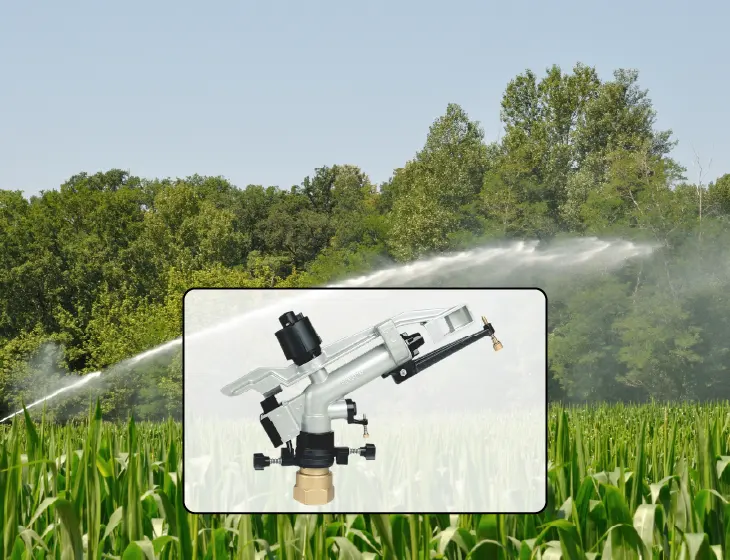
Irrigation challenges grow as field coverage increases. Methods that work well in smaller plots often fall short once the land opens up. In larger fields, wider spacing and pressure changes start showing up fast. Many farmers use a rain gun irrigation system here because it can cover longer distances while still keeping the spray pattern steady.
Rain guns make sense in large plots because a single unit can cover what would otherwise need several sprinklers. This makes them practical for open fields where coverage matters more than precise, plant-level control.
Why large fields need a different irrigation approach ?
As farm size increases, irrigation layouts usually have to change. Running dense pipe networks across wide plots adds cost and increases pressure loss along the line. In such cases, a rain gun sprinkler irrigation system offers a more workable option by covering more ground from a single point.
Rain guns operate at higher discharge rates, allowing water to travel farther before breaking into droplets. This reduces the number of installations needed and keeps system planning simpler, especially in broad, uninterrupted fields.
How rain gun irrigation sprinklers are built for open land ?
Rain gun irrigation sprinklers are designed with reach and durability in mind. Their construction allows them to handle higher operating pressures while maintaining smooth rotation. Many models include a jet breaker screw that lets the operator adjust the spray, shifting between heavier droplets and a finer spread based on crop needs or wind conditions.
Since these sprinklers sit out in the open, materials really matter. Aluminium die-cast bodies, brass parts, and stainless steel hardware are used because they handle pressure shifts, weather, and long working hours without giving trouble.
Rain gun how it works in everyday use
Understanding rain gun how it works does not require technical detail. Water enters the sprinkler through the mainline and is pushed through a high-discharge nozzle. The force of this flow drives the rotation mechanism, allowing the gun to sweep across a wide radius.
Depending on the setup, the sprinkler can rotate in a full circle or be limited to part-circle operation, which is useful along field edges. Once pressure is set within the recommended range, the system usually runs without needing constant adjustment.
Coverage and spacing across wide fields
One of the main reasons farmers choose a rain gun irrigation system is spacing flexibility. Depending on the model, a rain gun can throw water anywhere from about 18 metres to well beyond 40 metres, which means large areas get covered without having to overlap sprays again and again.
Correct spacing helps maintain even distribution while keeping pressure loss under control. This makes rain guns suitable for crops like sugarcane, maize, fodder, wheat, and other field crops that benefit from broad, uniform watering.
Using a rain gun for wheat cultivation
Wheat is typically grown in wide, open fields where the aim is even coverage, not pinpoint watering. In this kind of layout, a rain gun for wheat makes sense because it can reach across long rows without needing too many sprinklers set close together.
During stages like tillering and grain filling, rain guns help keep soil moisture fairly even across the field. When spacing and pressure are set correctly, the water spreads evenly and soaks in steadily, without pooling or running off.
Managing pressure variation along long pipelines
In large irrigation layouts, pressure naturally drops as distance increases. Rain gun irrigation sprinklers are designed to perform within defined pressure ranges so that small fluctuations do not disrupt rotation or coverage.
When operated within these limits, the sprinkler maintains steady discharge and predictable movement. This reliability reduces the need for frequent checks during irrigation hours.
Manual and automatic operation setups
An automatic rain gun irrigation system is usually paired with valves and controllers that manage irrigation timing and duration. Automation becomes useful in large fields where manual operation would require too much time and attention.
Rain guns are often operated manually and set on risers or simple stands. This gives farmers the freedom to move them as planting layouts change through the year.
Maintenance in real field conditions
Rain guns do need attention once in a while, but the work is usually simple. Most of the time, it comes down to checking the nozzle, making sure the jet breaker isn’t blocked, and seeing that the sprinkler is rotating freely.
Since everything is easy to reach, cleaning or small adjustments don’t take long and don’t need special tools. That makes it easier to keep irrigation running smoothly, even during busy parts of the season.
Choosing the right rain gun size
On compact layouts, smaller rain guns often do the job just fine. As fields get wider, farmers tend to move to larger units that can reach farther without compromising spread.
Farmers typically decide based on their crop, the scale of the field, how much water they can draw, and the pressure their setup can maintain.
How we approach rain gun irrigation systems ?
At Automat, our thinking around rain guns starts in the field, not on paper. The priority is simple things that matter during actual use: even water spread, steady movement, and parts that can stay outside and keep working through long irrigation hours.
We offer rain guns in different operating ranges so farmers can match them to their land without reworking the entire system or adding extra maintenance along the way.
Conclusion
A rain gun irrigation system is typically chosen when field size makes closely spaced sprinklers impractical. It allows water to be delivered over long distances with steady rotation, using fewer installations across the land.
When the right model is matched to field conditions and operated within recommended pressure limits, rain guns fit smoothly into seasonal irrigation routines. They handle large areas without fuss, don’t demand constant attention, and continue to work well as farms get bigger.
FAQs
What is the purpose of a rain gun in irrigation systems?
A rain gun is used to water large open fields where smaller sprinklers would need too many installations to be practical.
What is the pressure of a rain gun?
Most rain guns operate within a moderate to high pressure range, depending on the model, and work best when pressure stays steady.
How much area does a rain gun irrigation system cover?
Coverage can range from roughly 18 meters to over 40 meters in radius, based on nozzle size, pressure, and sprinkler design.
Is rain gun irrigation suitable for all crops?
It suits field crops and plantations well, but crops needing precise or low-volume watering may be better served by other methods.
What is the difference between rain gun and impact sprinkler?
Rain guns are built for long-distance, high-volume coverage, while impact sprinklers are meant for smaller areas and closer spacing.
Does a rain gun system require high water pressure?
It does need more pressure than small sprinklers, but many models are designed to perform reliably even at controlled operating levels.

Download Mobile App


Get in touch

Plot no. 18-19, Dilshad Garden, G.T. Road, New Delhi 110095.


