
Popular Searches
Popular Searches

Rain Gun Irrigation System for Large-Scale Potato Farming
Rain guns are often chosen when fields get large enough that managing multiple smaller sprinklers starts becoming difficult. They are designed to throw water over longer distances, making them useful where fewer units need to cover more ground.
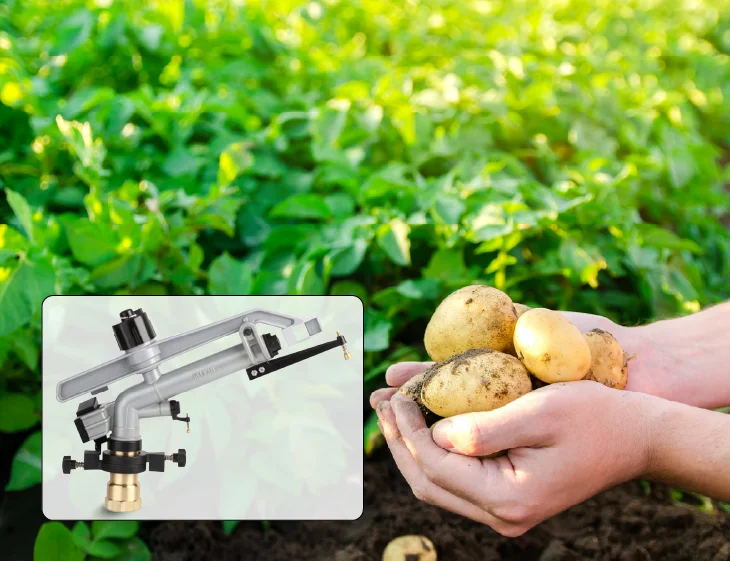
Rain guns are often chosen when fields get large enough that managing multiple smaller sprinklers starts becoming difficult. They are designed to throw water over longer distances, making them useful where fewer units need to cover more ground. As crops grow taller, this kind of overhead reach also becomes more practical compared to low-height systems.
They also tend to be one of the more cost-effective options for large areas, mainly because they reduce the number of pipes, joints, and connections required across the field.
Potatoes don’t respond well to uneven watering, especially once tubers start forming. Some parts of the field may hold moisture longer, while others dry out faster. On larger farms, keeping that balance even across the land takes more planning than it seems.
In larger fields, this becomes a day-to-day concern. Managing large scale potato irrigation is not just about running water through pipes. It’s also about noticing when one side of the field is getting a little less than the other, even if it’s not obvious at first.
Watering Potato crops and what actually happens in the field
A potato crop watering system really comes down to one thing. Keeping moisture around the roots fairly even. The tricky part is that potatoes grow underground. By the time uneven watering shows up above the surface, the difference has usually been there for a while.
In smaller plots, this is easier to manage. In bigger fields, things start behaving differently. A slight pressure drop, a longer pipe, or even a small slope in the land can slowly change how water spreads.
At first, it’s easy to miss. But after some time, you begin to notice areas that don’t quite match the rest of the field.
Farming in dry season
During potato farming in dry season, the soil tends to lose moisture faster than expected. A couple of warm days with some wind, and the top layer can dry out quickly.
At the same time, adding extra water doesn’t always fix it. Some parts of the field hold moisture longer, especially in heavier soils, and that can lead to other issues.
So farmers end up working around this balance. Not too much, not too little, and ideally spread evenly across the field. That gets harder to maintain as the field size increases.
Irrigation methods farmers usually try
There are different potato field irrigation methods, and most farmers go with what fits their setup. Drip works well where layouts are controlled. Smaller sprinklers are also used in tighter spaces. But as fields get larger, these setups start needing more pipes, more joints, and more attention.
And that’s where it starts to feel like extra work. More components usually mean more chances for uneven flow or small pressure differences. So over time, farmers begin looking for something that covers more area without adding more complexity.
At a larger scale
An Irrigation System for Potato Farming has to match the size of the field. What works in a 2-acre plot won’t behave the same way in 20 acres. This is where Rain Guns come in more naturally.
Instead of placing many smaller sprinklers across the field, farmers can use fewer units that throw water much farther. It reduces the number of setups and keeps things easier to handle.
Rain guns in everyday use
A rain gun sprinkler for potatoes is fairly simple in how it works. Water enters the sprinkler, passes through a nozzle, and that force drives the arm, making it rotate. As it rotates, it spreads water across a wide circle.
Once the pressure is set right, it usually keeps running without much adjustment. Farmers set it up, let it run, and just check in between to see that everything is moving properly.
Why Rain Guns fit well in bigger potato fields ?
The main reason farmers choose Rain Guns is simple. Coverage.
One unit can do the work of several smaller sprinklers. That means fewer pipes, fewer connections, and less time spent setting things up. This also keeps the overall setup more cost-effective, especially as field size increases.
As the crop grows, this becomes more noticeable. Rain guns still manage to throw water over the plants, while smaller sprinklers can start struggling to cover properly once the crop gets taller. In large fields, this makes a clear difference. The system feels easier to manage, and irrigation doesn’t take up the whole day.
What happens to pressure across long pipelines ?
In bigger layouts, water doesn’t behave the same from start to end. The farther it travels, the more the pressure can shift slightly.
Rain Guns are built to handle this to a certain extent. They work within a pressure range where small changes don’t stop the rotation or disturb the spread too much. So even if the pressure is not perfectly uniform, the sprinkler keeps doing its job without needing constant attention.
Built for actual field conditions
These sprinklers are not used in controlled environments. They stay out in the sun, deal with dust, and run for long hours. That’s why materials matter. Most rain guns are built using aluminium, brass parts, and stainless steel components so they can handle regular use without wearing out quickly.
There’s also a small adjustment feature in many models, like a jet breaker, which lets farmers change how the water falls. Heavier droplets or a finer spray, depending on what the field needs at that time.
How we approach rain gun systems ?
At Automat Global, we don’t really start from theory. We look at how irrigation actually plays out in the field. The aim is to keep things steady. The sprinkler should rotate properly, spread water evenly, and keep working without needing constant attention.
Our rain guns are designed to work within practical pressure ranges and real field conditions, so farmers don’t have to keep adjusting the system again and again.
Conclusion
Potato crops need steady moisture, especially when tubers are forming below the soil. In smaller fields, this is easier to manage. In larger ones, it takes more attention. Using too many small sprinklers can make the setup harder to handle. On the other hand, Rain Guns allow farmers to cover more area with fewer units, which keeps irrigation simpler.
When everything is set up properly, water spreads more evenly, and the field stays more consistent overall. And in potato farming, that consistency usually shows up in the final harvest.
FAQs
When should growers choose rain guns over drip irrigation for potatoes?
When fields are large and open, rain guns are easier to manage since they cover more area without needing dense pipe layouts.
What minimum pressure do rain guns need for good potato coverage?
Most setups work fine at a pressure where the sprinkler can rotate smoothly and throw water properly.
Can rain guns really increase potato crops and tuber uniformity?
They don’t directly increase yield, but more even watering usually helps the crop grow more consistently.
How large an area does a single rain gun typically handle?
In many cases, one sprinkler is enough to cover a large portion of the field, which cuts down the need for multiple smaller units.
What techniques help reduce wind interference with rain guns?
Farmers usually adjust droplet size or run irrigation during calmer hours to keep the spread more controlled.
How do rain guns compare to fixed overhead sprinklers for potatoes?
Rain guns cover larger areas with fewer units, while fixed systems offer tighter control but need more setup.

Download Mobile App


Get in touch

Plot no. 18-19, Dilshad Garden, G.T. Road, New Delhi 110095.


