
Popular Searches
Popular Searches

Plastic Impact Sprinklers Features, Advantages and Best Uses in Agriculture
A lot of farms rely on setups that can run without constant supervision. Fields are often large, water availability can be uneven, and time is split across multiple tasks.
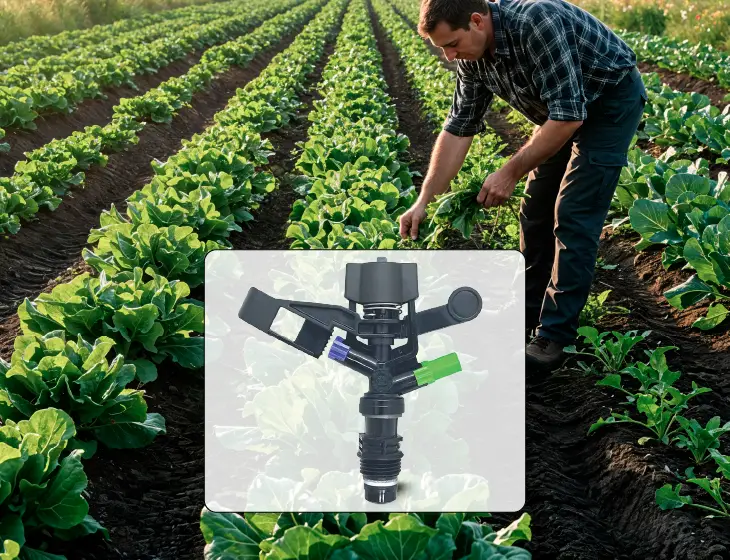
A lot of farms rely on setups that can run without constant supervision. Fields are often large, water availability can be uneven, and time is split across multiple tasks. That’s where systems that can keep running steadily on their own start to matter more than anything else.
Impact sprinklers are typically used in these conditions, especially where the land is spread out, the terrain is not perfectly even, and farmers are looking for a durable, cost-effective way to manage irrigation without adding too much complexity.
Plastic impact sprinklers in everyday irrigation
In most fields, irrigation is not something you keep adjusting all the time. Once things are set, you expect them to run the same way every day.
Plastic impact sprinklers are widely used for that reason. They don’t tend to change behaviour too easily. The rotation stays fairly steady, and the water spread remains consistent across the area.
Once the pressure is within the working range, they usually continue doing their job without needing constant checks. Over time, that kind of reliability becomes more noticeable than anything else.
Plastic irrigation system and how it all connects
Most farms today rely on a plastic irrigation system where pipes, fittings, and connectors are all designed to work together.
Using similar materials across the setup helps avoid small issues at joints and connections. There’s less stress on the system, and things tend to hold up better over time.
Plastic impact sprinklers fit naturally into this kind of layout. They are lightweight, easy to install, and don’t corrode when exposed to fertilizers or changing water conditions.
Impulse sprinkler agriculture and steady movement
In impulse sprinkler agriculture, the working is simple but effective. The sprinkler rotates because of a small arm that keeps striking the water stream. That repeated tapping motion is what keeps it moving in a controlled way.
Even when pressure varies slightly across the line, this mechanism helps maintain rotation. It may not be perfect in every spot, but it stays stable enough to avoid large dry or wet patches forming in the field.
Rotary impact sprinkler and field coverage
A rotary impact sprinkler covers the field gradually, one section at a time. Instead of throwing water all at once, it rotates step by step, allowing the water to fall more evenly across the area. When multiple units are placed correctly, their coverage overlaps just enough to keep distribution balanced.
This helps a lot in open fields where you have to be a bit careful with spacing, otherwise some areas get missed while others end up getting more water than needed.
Crop irrigation impact head and control over spread
The crop irrigation impact head is where most of the control comes from. Nozzle size, angle, and pressure together decide how far the water travels and how it spreads. Small adjustments here can change how the water behaves in the field.
For crops like vegetables or nursery plants, a softer and more controlled spread works better. In slightly larger plots, the water may need to travel a bit farther without breaking too soon. This flexibility allows farmers to adjust the same system for different crops without needing to replace the entire setup.
Durable plastic sprinkler and long-term use
Irrigation equipment stays out in the field for months at a time. Over time, these sprinklers just tend to hold up well in the field. They don’t rust, and they handle sun, fertilizers, and regular use without much trouble. So farmers usually keep using the same ones season after season. There’s not much to do either, just a quick check of the nozzle now and then, and clearing it if something gets stuck.
Plastic sprinklers for farming and crop suitability
Plastic sprinklers for farming are used across all kinds of crops. You’ll see them working well in vegetables, flowers, nursery plants, even pulses, mainly because the water spreads out evenly without hitting too hard. In plantations, the lower-angle ones help keep the water closer to the base instead of throwing it too high. That way, less water gets wasted and it actually goes where it’s needed.
Where plastic impact sprinklers fit best
Not every irrigation setup needs the same approach.
In very large, open fields where water needs to travel long distances, other systems may be more suitable. But for most medium-sized farms, plastic impact sprinklers offer a practical balance.
They cover a reasonable area while still keeping the water spread controlled enough for regular crops. For most day-to-day farm setups, that tends to work just fine.
How we approach plastic impact sprinklers ?
At Automat Global, the focus stays on how these systems actually perform once they are out in the field. Plastic impact sprinklers are designed to keep rotation stable, water spread even, and performance consistent over long hours of use.
The idea is not to complicate irrigation, but to make sure it stays predictable. When the system runs the same way day after day, farmers don’t have to keep stepping in to fix small issues.
Conclusion
Irrigation rarely fails all at once. It usually shifts slowly. A little unevenness here, a slight change in coverage there, and over time the field starts responding to it.
Plastic impact sprinklers help keep things steady. They maintain consistent rotation, distribute water evenly, and continue working through regular field conditions without needing much attention. In farming, where the same work repeats every day, that kind of consistency ends up making a bigger difference than expected.
FAQs
What makes plastic impact sprinklers better for mineral-rich water?
Even if the water has minerals in it, these don’t get affected much, so they usually keep running just fine.
How uniform is the coverage from plastic impact sprinklers?
When set up properly, the water spreads quite evenly, especially once multiple sprinklers are spaced to overlap.
Can plastic sprinklers handle high-pressure agricultural systems?
Most models handle regular farm pressure well, as long as they’re used within the recommended range.
How to adjust throw distance and pattern on plastic models?
You can tweak the nozzle size, angle, or pressure to change how far and how widely the water spreads.
How do plastic impact sprinklers compare to gear-driven types?
Impact sprinklers are simpler and easier to maintain, while gear-driven ones are usually quieter and more precise.

Download Mobile App


Get in touch

Plot no. 18-19, Dilshad Garden, G.T. Road, New Delhi 110095.


