
Popular Searches
Popular Searches

Best Irrigation Practices for Potato Crops Using Plastic Impact Sprinklers
There’s something about potatoes that everyone connects with. From simple home meals to street food favourites, they show up everywhere.
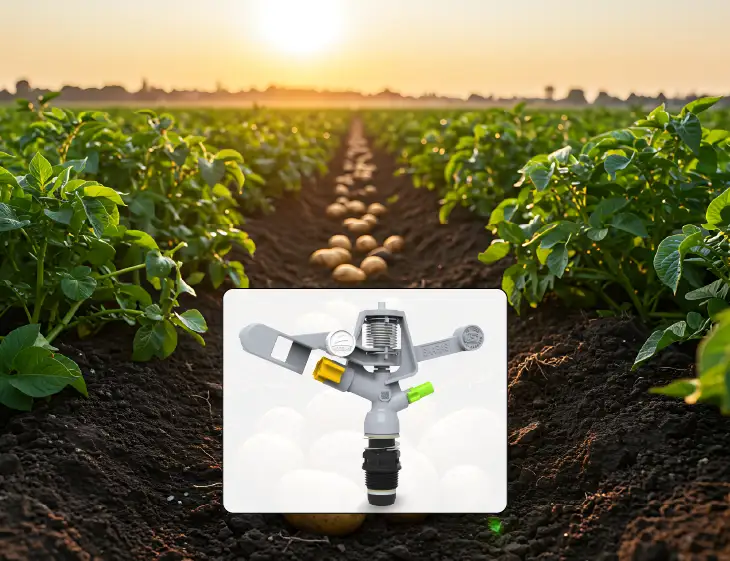
There’s something about potatoes that everyone connects with. From simple home meals to street food favourites, they show up everywhere. But out in the field, growing a good potato crop is far less simple. What looks like an easy crop on the plate actually depends on careful irrigation, especially when it comes to how evenly water reaches the soil.
Potato crops don’t really show their problems early. The leaves might look fine, the rows look green, everything seems normal. But underneath, where the crop is actually forming, uneven moisture can already start affecting things. Farmers usually notice it later, when the size and consistency of the potatoes aren’t quite what they expected.
Because of this, irrigation is less about “giving water” and more about how that water moves across the field. That’s where Plastic Sprinklers come in. They help spread water in a way that’s more even, without needing constant adjustments.
Impact sprinkler potato irrigation and field coverage
In impact sprinkler potato irrigation, the main concern is simple. Water should not collect in one place and skip another. It sounds obvious, but it happens more often than people think.
Impact sprinklers handle this quite well because of how they move. The arm keeps tapping the water stream and slowly turns the sprinkler, so the spray keeps shifting. Over time, that movement helps cover a wider area without focusing too much on one spot.
When spacing is planned properly, the field tends to get a more even spread. That usually reflects in how the crop grows across different rows.
Plastic sprinkler for potato crops and practical use
A plastic sprinkler for potato crops is often preferred for a very practical reason. It is easier to handle.
Potato fields are not always fixed setups. Lines get moved, sections get adjusted, and sometimes only parts of the field need irrigation. Lighter sprinklers make this easier to manage without adding extra effort.
Another thing farmers notice is that plastic doesn’t really react much to water quality. Even when the water carries some minerals, the sprinkler usually keeps working the same way. That consistency matters more than anything fancy.
Wind resistant potato sprinkler and open field conditions
Open fields bring their own challenges. Wind is one of them.
When the wind picks up, water doesn’t always fall where you expect it to. It drifts, breaks, or lands unevenly. That’s where a wind resistant potato sprinkler helps a bit.
Some designs keep the spray more stable by controlling how the water leaves the nozzle. It doesn’t completely solve the problem, but it reduces how much the spray gets pushed around.
Most farmers also adjust timing. Early morning or late evening usually works better when the air is calmer.
Low pressure sprinkler potato irrigation systems
Not every farm runs on perfect pressure. Sometimes the pump output drops. Sometimes the line is too long. Sometimes multiple sections are running at once.
That’s where a low pressure sprinkler potato setup makes things easier. Sprinklers that can keep rotating even when pressure dips are simply more reliable in these situations.
They don’t need to be pushed hard to keep working. And when the system isn’t under strain, everything tends to last longer.
Plastic sprinkler for potato and system compatibility
A plastic sprinkler for potato setups also fits well with the rest of the system. Most pipelines and fittings in these fields are already plastic, so everything connects without much trouble.
There’s also less wear at the joints. Since the materials are similar, the system feels more balanced overall.
Over time, farmers usually notice that those small, recurring issues don’t show up as often.
And with potatoes, that’s what it really comes down to. The field getting water as evenly as possible.
Potatoes don’t respond well to uneven moisture. Too much water in one area and too little in another almost always shows up later.
That’s one reason Plastic Sprinklers are used so widely. They don’t try to do anything complicated. They just keep turning and spreading water in a steady pattern.
When that stays consistent, the field behaves more evenly.
Durability in everyday field conditions
Sprinklers stay out in the field all the time. Sun, dust, fertilizer, constant water flow. It all adds up.
Plastic impact sprinklers are built to handle that kind of use. They don’t rust, and they don’t need much attention once they are set up properly.
Most of the time, maintenance is simple. Clean the nozzle, check that the arm is moving freely, and that’s about it.
Our approach to irrigation systems
At Automat Global, we usually think about what happens after installation. Once the system is running in the field, it should not need constant attention.
Our Plastic Sprinklers are designed to keep things simple. They rotate steadily, work within a practical pressure range, and hold up under regular use.
Models like the AQ-22 and AQ-46 are built with this in mind. The idea is not to complicate irrigation, but to keep it predictable.
Conclusion
Potato crops depend on what’s happening below the surface, and irrigation plays a big part in that. You don’t always see the effect immediately, but it shows up later in the harvest.
Keeping water distribution steady across the field makes a noticeable difference.
Plastic sprinklers help keep things steady without adding extra work. Get the setup right, and you don’t have to keep going back to fix or adjust it all the time.
FAQs
Which plastic impact sprinkler models perform best on potatoes?
Models that maintain steady rotation and even spread, like AQ-22 or similar mid-range sprinklers, usually work well for potato fields.
What pressure settings work optimally for plastic potato systems?
You don’t need very high pressure. Just enough for the sprinkler to keep moving smoothly is usually good enough.
Do plastic sprinklers reduce risks like hollow heart or greening?
They can help indirectly, since more even watering supports uniform tuber growth and reduces stress on the crop.
In what scenarios are plastic sprinklers preferable to rain guns?
They’re usually better for smaller or medium fields where controlled, even coverage matters more than long-distance throw.

Download Mobile App


Get in touch

Plot no. 18-19, Dilshad Garden, G.T. Road, New Delhi 110095.


